- All courses offered
- Bachelor
- Computational Linguistics
- Major Subject (Academic)
Computational Linguistics Major Subject (Academic)
Overview


Contents of the subject Computational Linguistics
An interest in language and enjoyment of analytical thinking are good prerequisites for studying computational linguistics. Linguistic communication is something we humans take for granted every day. However, if you try to model language and interaction with computers, it quickly becomes clear how complex our linguistic knowledge actually is.
The Computational Linguistics programme teaches how linguistic structures and processes of language processing can be investigated using logical-mathematical, empirical, and technical means. Students of Computational Linguistics learn about different linguistic, formal-theoretical and technical approaches to phenomena of language and interaction. They acquire knowledge and practical experience in dealing with linguistic data and with methods of analysing, modelling, and structuring this data.
At Bielefeld University, Computational Linguistics is part of the Faculty of Linguistics and Literary Studies and thus linguistically oriented. Skills such as computer programming and algorithmic and formal thinking are taught in courses that are tailored to (computational) linguistic fields of work. For the Bachelor's major subject in Computational Linguistics, both a number of minor subjects from the humanities and from the areas of computer science and mathematics, are particularly suitable.
Methods and technologies from computational linguistics are required in various application areas. Graduates of Computational Linguistics thus have career prospects in fields such as artificial intelligence, data analysis, or human-computer interaction, among others.
Contact persons
Advantages of the subject Computational Linguistics at Bielefeld University
Career prospects
Software development: Graduates find employment in software development, particularly in companies specialising in natural language processing, machine learning or artificial intelligence. Here, they can contribute to innovative applications and products.
Data analysis: Career opportunities also exist in data analysis, where specialists evaluate and interpret large volumes of data to gain insights into linguistic patterns and user behaviour.
Research and teaching: An academic career in research and teaching at universities is also an option. Graduates can take up positions in university teaching and lead their own research projects.
Technology consultancy: These qualifications enable graduates to work in technology consultancy, where experts support companies in efficiently implementing and utilising language technologies.
Language and Text Processing: Graduates can work in the field of language and text processing, for example in publishing houses, media companies or international organisations. There, they are responsible for the development, implementation and optimisation of language-based systems.
What are the access requirements?
Access to the Bachelor programme is granted to those who have a university entrance qualification suitable for Germany (e. g. German ‘Abitur’).
Please note that further approval requirements also apply for this subject:
In addition to the usual documents, a certificate from the Faculty confirming English language proficiency at level B2 of the Common European Framework of Reference for Languages from a recognised body (e.g. continued foreign language English at the end of the qualification phase of the upper secondary school or a language certificate generally recognised by German universities, in particular TOEFL, telc, IELTS, UNIcert, Cambridge Certificate) must be submitted upon enrolment.
To obtain such a certificate, please contact the academic advisor by email (see persons to contact in the navigation bar).
Please also read the subject-specific regulations, which are decisive for all applicable regulations.
Special conditions apply to applicants with a foreign certificate of education.
Likewise, special conditions apply to those qualified in vocational education and training.
What formalities are important?
Course start
Studies can be commenced in both winter and summer semesters. Courses are targeted to commencing studies in winter semester. Student counselling to plan the course of studies is recommended.
Length and scope of studies
The standard period of studies is 6 semesters. Information on studying part time.
The studies Major Subject (Academic) Computational Linguistics comprise 120 credit points.
Find out about the academic structure model and note the possible combinations as well as the rules regarding the individual supplementary area.
Application, admission, and enrolment
The study places are not subject to any admission restrictions (numerus clausus). Nevertheless, you need to apply within the currently applicable application deadlines. Afterwards, however, you can submit your application for enrolment directly in the application and status portal, provided that you meet the access requirements.
Step by step to a bachelor programme without NC
Special conditions apply to applicants with a foreign certificate of education.
Likewise, special conditions apply to those qualified in vocational education and training.
The courses
You will find the programme of lectures for this course in the eKVV.
An overview of the introductory and information events is provided by the central student counselling services.
Possible Combinations
 Possible Combinations
Possible combinations for Combined Bachelor
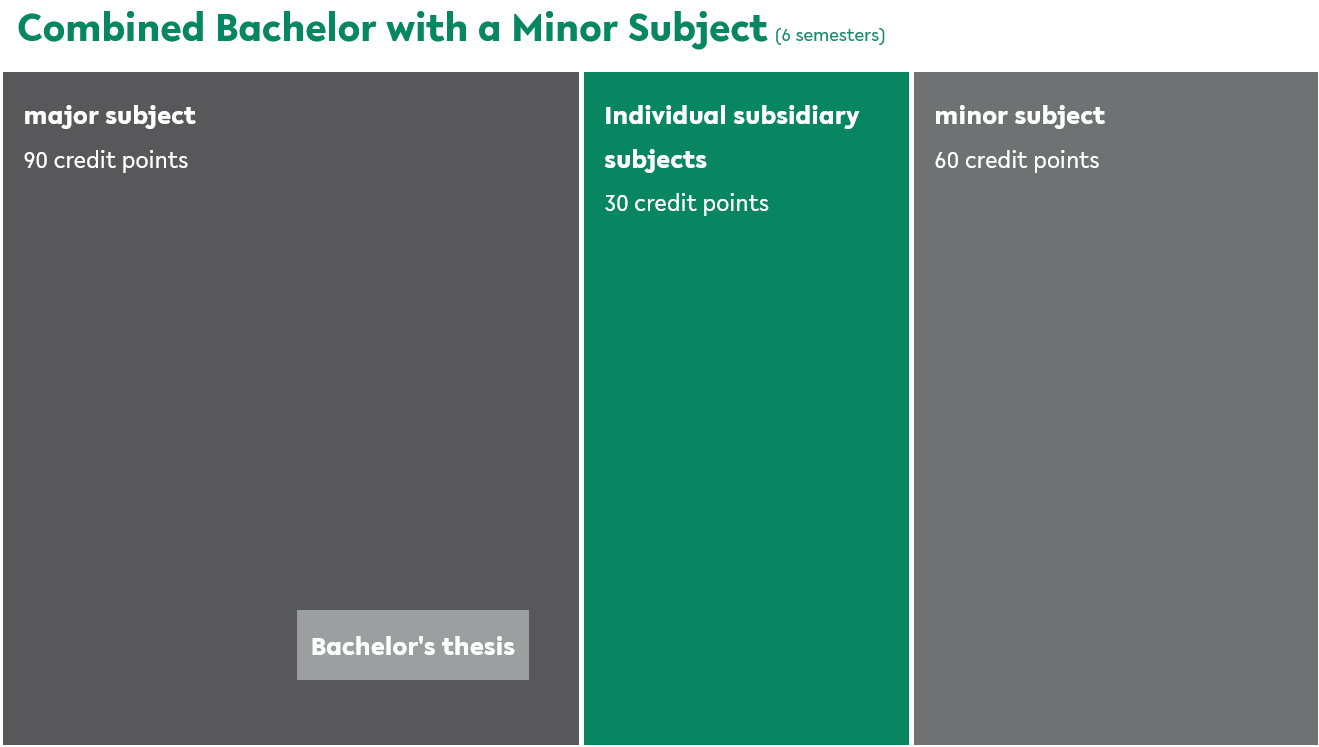
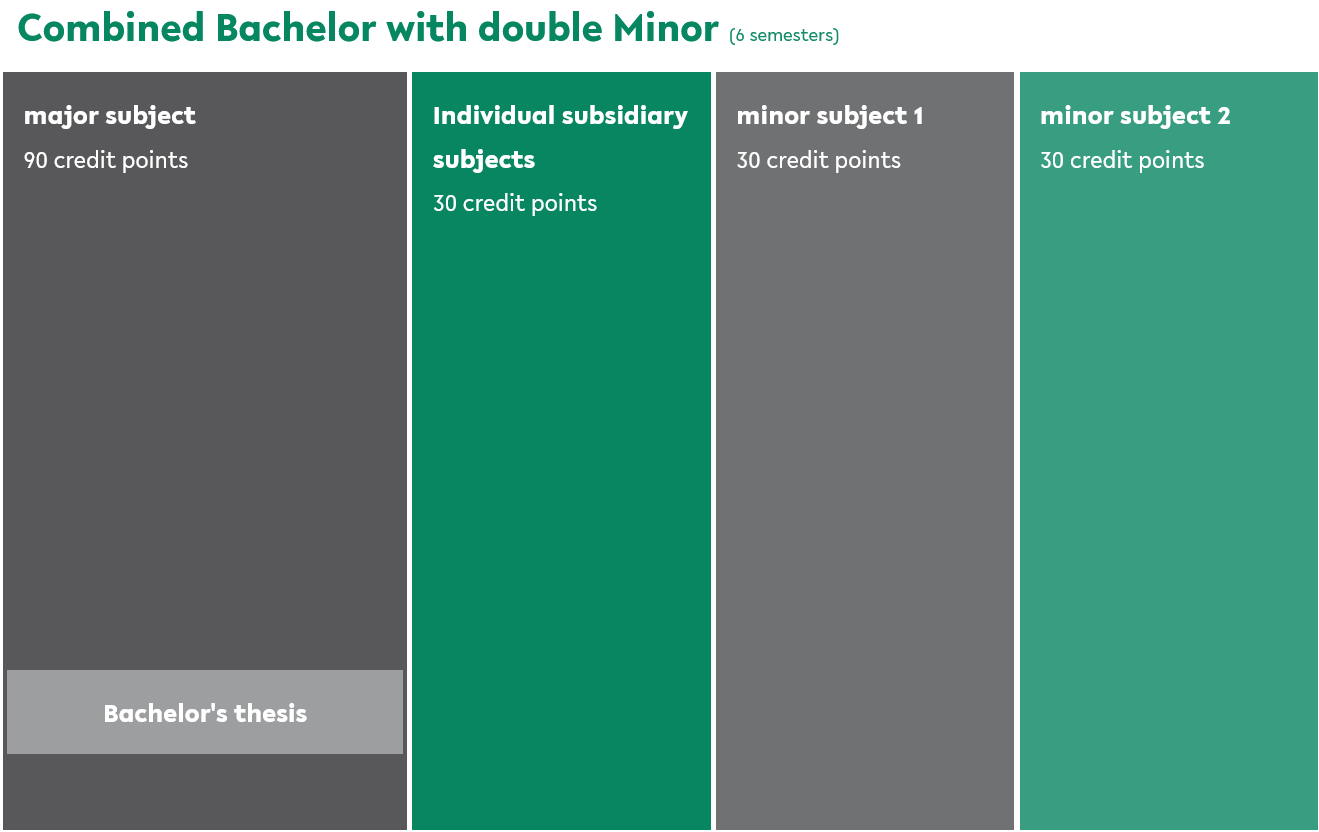
Legend
- 1
-
The information on admission restrictions / numerus clausus (NC) refers to applications for the winter semester 2026/27 and summer semester 2027.
Information on NC values from previous years