- All courses offered
- Bachelor
- Aesthetic Education
- Minor Subject (Academic), 30 CPs
Aesthetic Education Minor Subject (Academic), 30 CPs
Overview


Contents of the subject Aesthetic Education
Please note: Further approval requirements for the profile 'Music' will no longer apply for the winter semester 2026/27. For further information, see below: What are the access requirements?
Aesthetic education plays an important role not only in general education schools, but also to a special degree in educationally related professional fields such as extracurricular education in music and art schools, in adult education, in publishing houses, in education-related research institutions or in the museum sector. The subject-specific degree programme in Aesthetic Education is particularly aimed at students of the humanities and social sciences. When applying (aptitude assessment), students decide between a profile in art or a profile in music.
The Minor Subject offers students the opportunity to build up and expand competences specific to art or music in the areas of aesthetic education, theory of the arts and artistic or musical practice. In doing so, they gain individual perspectives on theories and practices of aesthetic educational processes, which are expanded by contents from art or music studies and aspects of extracurricular cultural mediation.
Contact persons
Advantages of the subject Aesthetic Education at Bielefeld University
Career prospects
Extracurricular education: A career in extracurricular education, for example in music and art schools or in adult education, is also possible. Here, graduates can put their creative and teaching skills to good use.
Cultural institutions: The degree programme qualifies graduates for roles in cultural institutions such as museums or galleries, where an understanding of aesthetic educational processes is important. Here, graduates can design and deliver educational programmes.
Research and academia: An academic career in research or teaching at universities is also a possibility for graduates. The sound theoretical training opens up opportunities for scholarly engagement with topics relating to aesthetic education.
Publishing and media: The knowledge gained can also be applied in publishing houses or within the media industry, for example in the development of educational content or in editorial work focusing on aesthetic topics.
What are the access requirements?
Access to the Bachelor programme is granted to those who have a university entrance qualification suitable for Germany (e. g. German ‘Abitur’).
Please note that further approval requirements also apply for this subject:
For the profile 'Art' a prerequisite for enrolment is a proof of artistic aptitude, which serves to determine whether an applicant fulfils the requirements that can be expected to achieve the study objective (aptitude assessment procedure).
For the profile 'Music', the aptitude assessment will not apply for the winter semester 2026/27. If you want to study the profile 'Music' from the 2026/2027 winter semester onwards, please contact the department.
Further information on this can also be found via the link below:
Further information on the individual examination components, the procedure and dates
Special conditions apply to applicants with a foreign certificate of education.
Likewise, special conditions apply to those qualified in vocational education and training.
What formalities are important?
Course start
Studies can be commenced in both winter and summer semesters. Courses are targeted to commencing studies in winter semester. Student counselling to plan the course of studies is recommended.
Length and scope of studies
The standard period of studies is 6 semesters. Information on studying part time.
The studies Minor Subject (Academic), 30 CPs Aesthetic Education comprise 30 credit points.
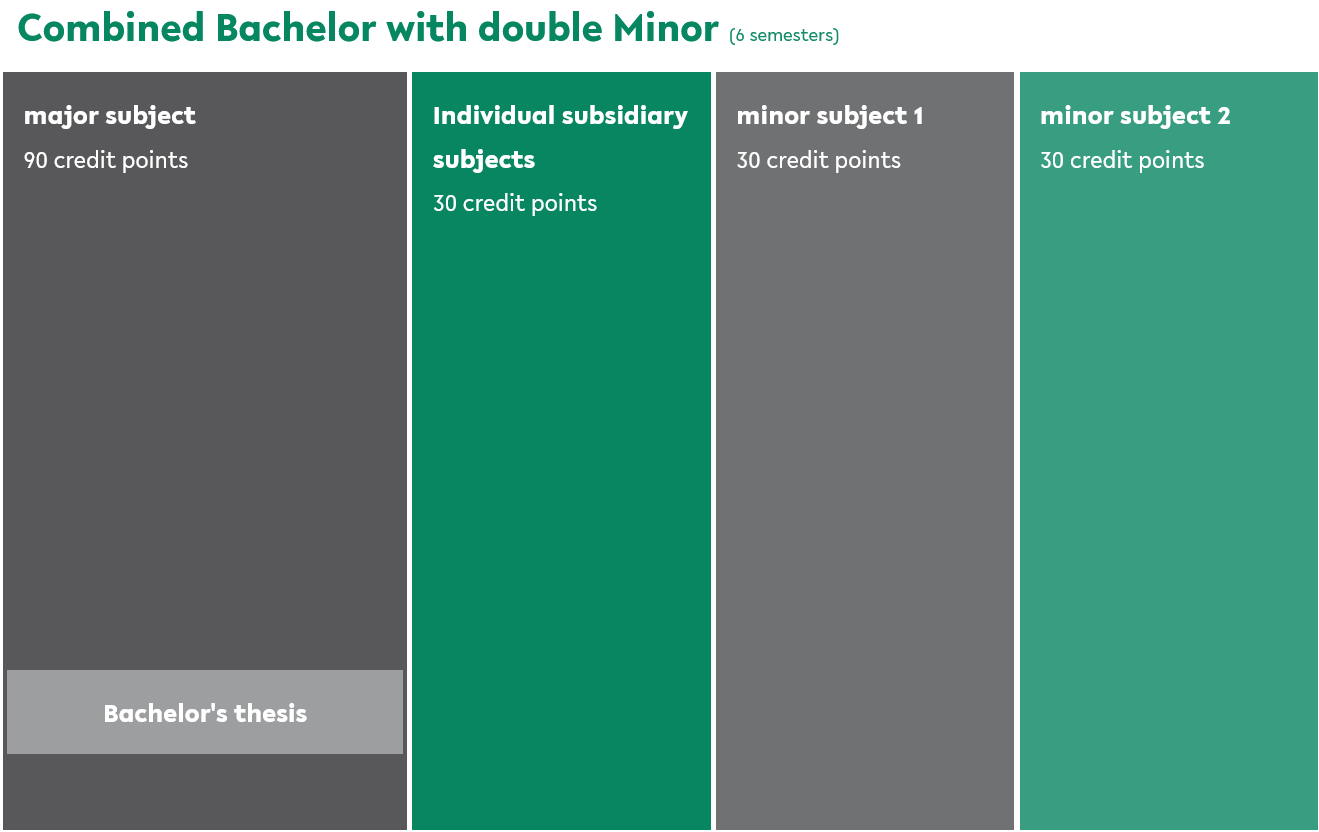
Find out about the academic structure model and note the possible combinations as well as the rules regarding the individual supplementary area.
Application, admission, and enrolment
The study places are not subject to any admission restrictions (numerus clausus). Nevertheless, you need to apply within the currently applicable application deadlines. Afterwards, however, you can submit your application for enrolment directly in the application and status portal, provided that you meet the access requirements.
Step by step to a bachelor programme without NC
Special conditions apply to applicants with a foreign certificate of education.
Likewise, special conditions apply to those qualified in vocational education and training.
The courses
You will find the programme of lectures for this course in the eKVV.
An overview of the introductory and information events is provided by the central student counselling services.
Possible Combinations
 Possible Combinations
Possible combinations for Combined Bachelor
Legend
- 1
-
The information on admission restrictions / numerus clausus (NC) refers to applications for the winter semester 2026/27 and summer semester 2027.
Information on NC values from previous years