- All courses offered
- Bachelor
- Latin: Roman Literature, Culture and Society in European Context
- Minor Subject (Advanced Secondary and Comprehensive Schools ('Gymnasium' and 'Gesamtschule'))
Latin: Roman Literature, Culture and Society in European Context Minor Subject (Advanced Secondary and Comprehensive Schools ('Gymnasium' and 'Gesamtschule'))
Overview


Contents of the subject Latin: Roman Literature, Culture and Society in European Context
Das Studium richtet sich an Studierende, die das Lehramt Latein an Gymnasien und Gesamtschulen anstreben. Die Vermittlung fachwissenschaftlicher Inhalte zur lateinisch-römischen Sprache, Literatur, Kultur und Gesellschaft geschieht im Kontext einer europa- und gegenwartsbezogenen Rezeption der Antike und soll in dieser bewussten Verortung die Studierenden über die fachwissenschaftlichen Kenntnisse und Kompetenzen hinaus befähigen, ein reflektiertes Verständnis von Europa und seiner Geistesgeschichte zu entwickeln und in ihrem künftigen Berufsleben als Lehrer*in entsprechend zu vermitteln. Zugleich erwerben die Studierenden die für den modernen Latein-Unterricht fachdidaktischen Kompetenzen und lernen, ihre fachdidaktischen Erkenntnisse und Kompetenzen auf die Lehr- und Lernperspektive in Unterrichts-Kontexten zu übertragen.
Contact persons
Advantages of the subject at Bielefeld University
Career prospects
When choosing subjects, it is also important to take your own interests into account so that you can later teach the subjects you are interested in with enthusiasm. Furthermore, considering the age of the pupils in the respective types of school is helpful in making an informed decision.
What are the access requirements?
Access to the Bachelor programme is granted to those who have a university entrance qualification suitable for Germany (e. g. German ‘Abitur’).
Please note that there are also 'additional access requirements' for this subject:
Proof of the Latinum is required for entry.
Please also be sure to read the subject-specific regulations, which take precedence over all other applicable rules.
Please note: When transferring to the Master of Education degree programme with the subject of Latin and the career goal of teaching at Advanced Secondary and Comprehensive Schools ('Gymnasium' and 'Gesamtschule'), proof of the German "Graecum" is required for the degree of Master of Education up to and including the winter semester 2028/29. From the summer semester 2029, proof of the German "Graecum" is already required for enrolment (and not only for the degree) of the degree programme.
Special conditions apply to applicants with a foreign certificate of education.
Likewise, special conditions apply to those qualified in vocational education and training.
What formalities are important?
Course start
Studies can be commenced in both winter and summer semesters. Courses are targeted to commencing studies in winter semester. Student counselling to plan the course of studies is recommended.
Length and scope of studies
The standard period of studies is 6 semesters. Information on studying part time.
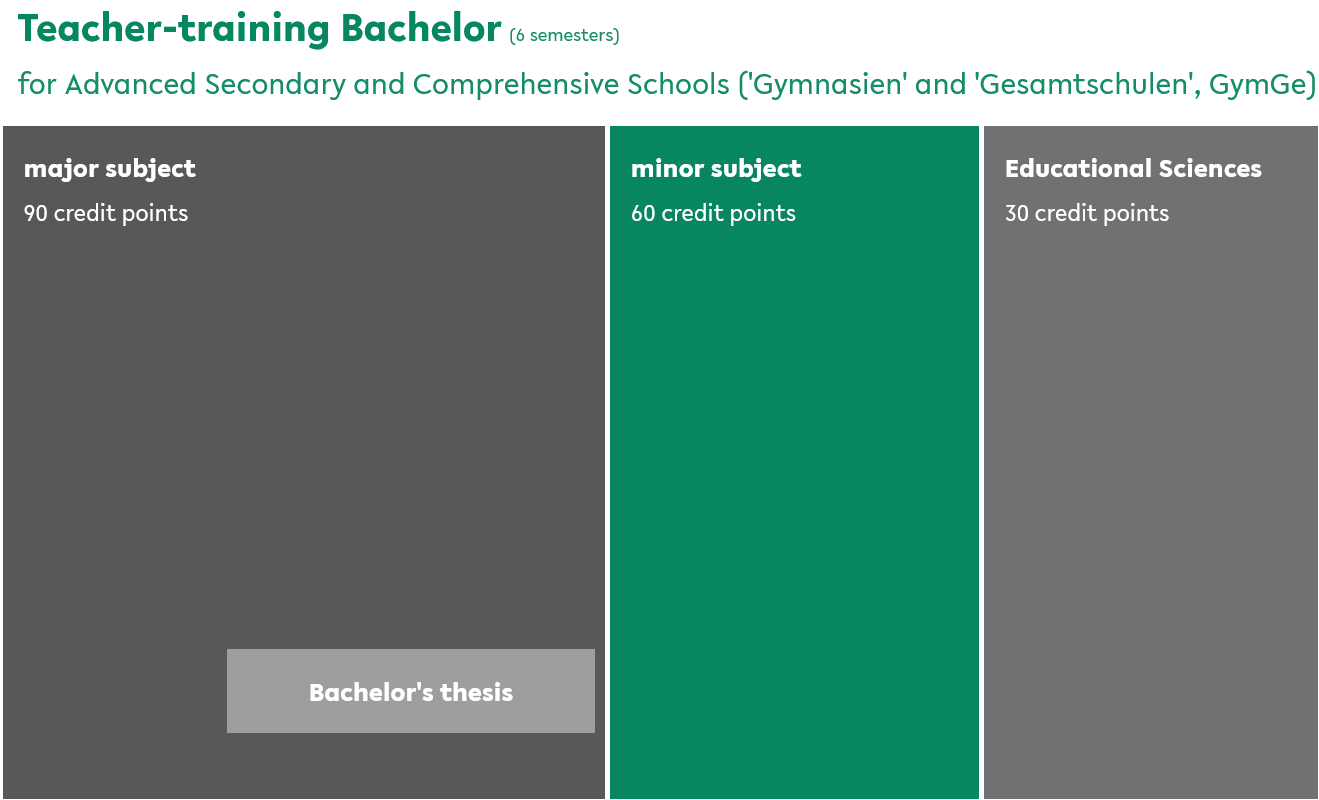
The studies Minor Subject (Advanced Secondary and Comprehensive Schools ('Gymnasium' and 'Gesamtschule')) Latin: Roman Literature, Culture and Society in European Context comprise 60 credit points.
Find out about the academic structure model and note the possible combinations.
Application, admission, and enrolment
The study places are not subject to any admission restrictions (numerus clausus). Nevertheless, you need to apply within the currently applicable application deadlines. Afterwards, however, you can submit your application for enrolment directly in the application and status portal, provided that you meet the access requirements.
Step by step to a bachelor programme without NC
Please note that Education Sciences is always a compulsory component of a degree programme with a teaching option (see study structure model).
Special conditions apply to applicants with a foreign certificate of education.
Likewise, special conditions apply to those qualified in vocational education and training.
The courses
You will find the programme of lectures for this course in the eKVV.
An overview of the introductory and information events is provided by the central student counselling services.
Possible Combinations
 Possible Combinations
Possible combinations for Combined Bachelor with teaching option
Legend
- 1
-
The information on admission restrictions / numerus clausus (NC) refers to applications for the winter semester 2026/27 and summer semester 2027.
Information on NC values from previous years