- All courses offered
- Bachelor
- German Languages and Literatures
- Minor Subject (Academic), 60 CPs
German Languages and Literatures Minor Subject (Academic), 60 CPs
Overview


Contents of the subject German Languages and Literatures
Das Fach Germanistik umfasst die wissenschaftliche Auseinandersetzung mit der deutschen Sprache und Literatur vom Mittelalter bis zur Gegenwart. Der Studiengang richtet sich an alle, die diese Gegenstandsbereiche in ihrer Vielfalt und in ihren Wechselbezügen kennenlernen wollen. Die Studierenden machen sich mit der disziplinären und historischen Bandbreite von Linguistik, Literaturwissenschaft und Mediävistik vertraut.
Das Studium zeichnet sich durch einen verstärkt empirischen Zugang zur Grammatikforschung und Kommunikationsanalyse aus, durch den die Studierenden bspw. psycholinguistische Perspektiven, genderrelevante Aspekte der Sprache sowie Sprachgebrauch und Sprachnorm in unterschiedlichen Kontexten kennenlernen. Dadurch erwerben sie Kernkompetenzen, analytisch mit geschriebenen und gesprochenen Sprachdaten umzugehen und Sprache in unterschiedlichen Medien situationsadäquat einzusetzen. Zudem deckt das Studium einen breiten literaturgeschichtlichen Horizont ab, der das Mittelalter und unsere Gegenwart einschließt. Vermittelt werden theoretisch wie medial reflektierte Zugänge zur Literaturgeschichte – eine Methodenvielfalt, die von qualitativen bis zu digitalen Ansätzen reicht, – und gattungsspezifische, interdisziplinäre sowie gesellschaftstheoretische Perspektiven auf literarische Texte.
Besonderes Kennzeichen des Bielefelder Germanistik-Studiums ist die Verbindung einer qualitativ hohen wissenschaftlichen Ausbildung in allen drei Kernbereichen (Sprachwissenschaft, Literaturwissenschaft, Mediävistik) mit dem Anspruch hochschuldidaktischer Innovation in den Bereichen Curriculumsentwicklung und Digitalität (einschließlich Digital Humanities). Im Studium verankert ist eine explorative und kollaborative Lernkultur, die neben der fachwissenschaftlichen Grundausbildung kommunikative, kooperative und mediale Kompetenzen schult.
Contact persons
Advantages of the subject at Bielefeld University
At the heart of this specialist degree programme lies the academic study of the German language and literature from the Middle Ages to the present day. Students gain an understanding of these subject areas in all their diversity and interrelationships, and become familiar with the disciplinary and historical scope of linguistics, literary studies and medieval studies. Over the course of your studies, you will develop your own subject-specific interests, which can be further specialised in the second phase of the programme.
Practical Training
The German Studies degree programme qualifies graduates for a broad job market in which the ability to communicate complex issues is becoming increasingly important. In addition to training for an academic career, the version of the degree programme prepares students for all non-school-based professional fields in which communication plays a central role: education and adult education, language teaching, media professions, advertising, editing, literary publishing, cultural management, public relations, specialist journalism, literary and cultural work, and theatre.
Interdisciplinary Approaches
The combination of elements from linguistics, literary studies and media studies, alongside digital studies, opens up an interdisciplinary perspective on the subjects of language and literature. This versatility fosters an understanding of different media and their relevance in education. The degree programme benefits from the cross-philological, interdisciplinary orientation of the LiLi Faculty. The versatility of the courses enables a high degree of interconnection between the various versions of degree programmes, thereby promoting interdisciplinarity in individual study planning as well as continuous exchange between the degree programmes.
Internationalisation
The programme places great emphasis on international perspectives and collaborations, giving students the opportunity to undertake periods of study abroad – for example, through Erasmus and other partnerships – and to broaden their skills in an international context. Furthermore, students on the programme benefit from the presence of international students and the resulting exchange, in that they develop intercultural skills and sensitivity, enabling them to navigate a globalised environment, as well as international academic and professional contexts, with ease even after completing their studies.
Personalised support
Students benefit from personalised support from teaching staff, which enables close guidance throughout their studies. This supports their personal and academic development and fosters a trusting learning environment. This close support ensures that the content of teaching can be linked to students’ individual practical projects and research interests. Students develop into independent individuals who are well prepared to meet the complex demands of the modern labour market.
Career prospects
Culture and media management: Graduates can work in cultural and media organisations, where they are responsible for planning and organising events, as well as for the content of media productions.
Publishing: A career in publishing is also possible, particularly in editorial and proofreading roles, where professionals oversee texts and support the publication of books and other media products.
Public communications: The skills acquired qualify graduates for roles in public communications, for example in PR agencies or in the public relations departments of companies and organisations.
Research and academia: Graduates have the opportunity to work in research, for example at universities or research institutes, where they can carry out their own projects and contribute to academic discourse.
Social and cultural institutions: Positions in social and cultural organisations also offer career prospects, where graduates can develop and implement programmes to promote literature and language.
What are the access requirements?
Access to the Bachelor programme is granted to those who have a university entrance qualification suitable for Germany (e. g. German ‘Abitur’).
Special conditions apply to applicants with a foreign certificate of education.
Likewise, special conditions apply to those qualified in vocational education and training.
What formalities are important?
Course start
Studies can be commenced in both winter and summer semesters. Courses are targeted to commencing studies in winter semester. Student counselling to plan the course of studies is recommended.
Length and scope of studies
The standard period of studies is 6 semesters. Information on studying part time.
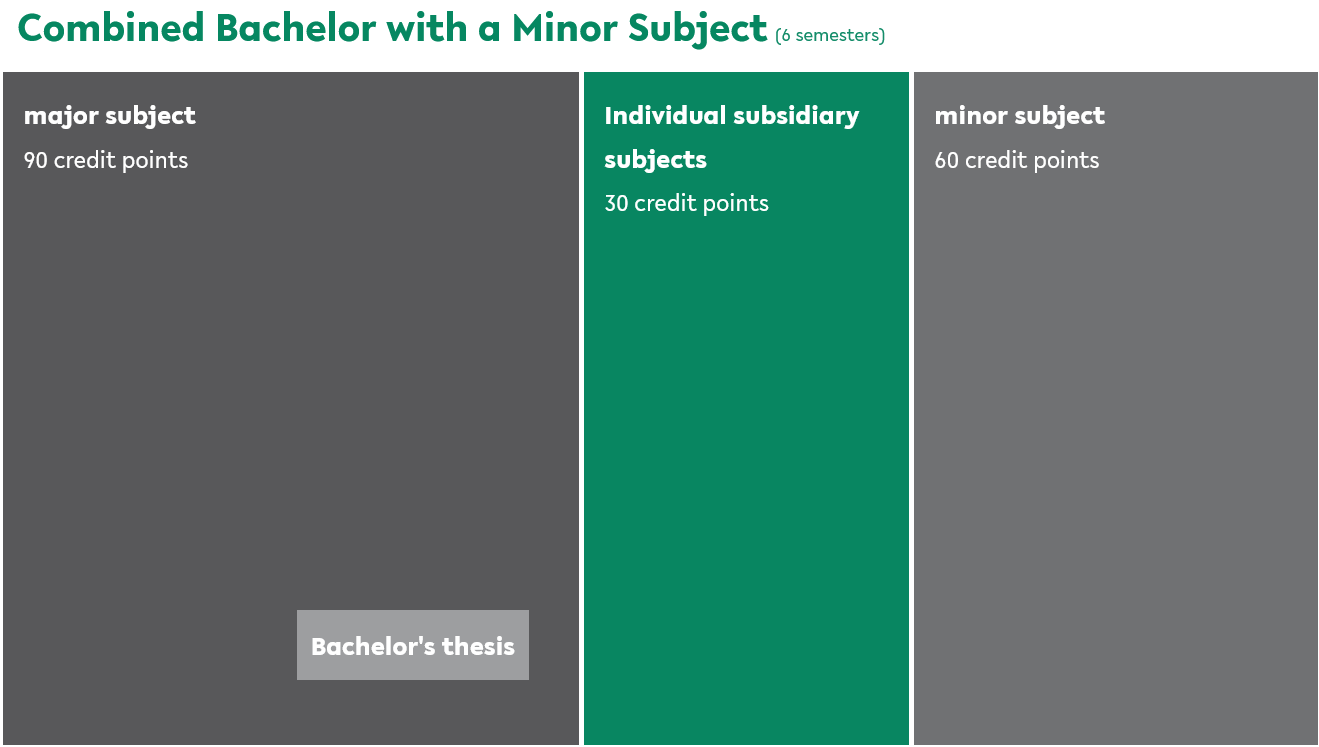
The studies Minor Subject (Academic), 60 CPs German Languages and Literatures comprise 60 credit points.
Find out about the academic structure model and note the possible combinations as well as the rules regarding the individual supplementary area.
Application, admission, and enrolment
The study places are not subject to any admission restrictions (numerus clausus). Nevertheless, you need to apply within the currently applicable application deadlines. Afterwards, however, you can submit your application for enrolment directly in the application and status portal, provided that you meet the access requirements.
Step by step to a bachelor programme without NC
Special conditions apply to applicants with a foreign certificate of education.
Likewise, special conditions apply to those qualified in vocational education and training.
The courses
You will find the programme of lectures for this course in the eKVV.
An overview of the introductory and information events is provided by the central student counselling services.
Possible Combinations
 Possible Combinations
Possible combinations for Combined Bachelor
Legend
- 1
-
The information on admission restrictions / numerus clausus (NC) refers to applications for the winter semester 2026/27 and summer semester 2027.
Information on NC values from previous years